


Is A2 Stellar Hunter Better Than Fixed Automation in 2026?
- Jul 27
- 2 min read
Updated: Jul 28
AI-driven workcells are reducing setup time and skilled-labor pressure inside factories, while distributed inspection remains outside their reach. The useful comparison is therefore not quadruped versus robot arm in the abstract; it is stationary manipulation versus mobile sensing, with each platform assigned to the workflow it physically solves.
Why is this comparison relevant now?
AI-driven welding and manufacturing systems are making fixed automation easier to program and more repeatable inside production cells. Toborlife AI sees the adjacent gap remain unresolved, where an A2 robot for sale becomes commercially relevant when inspection, mapping, or sensing must travel between cells instead of staying bolted to one station.

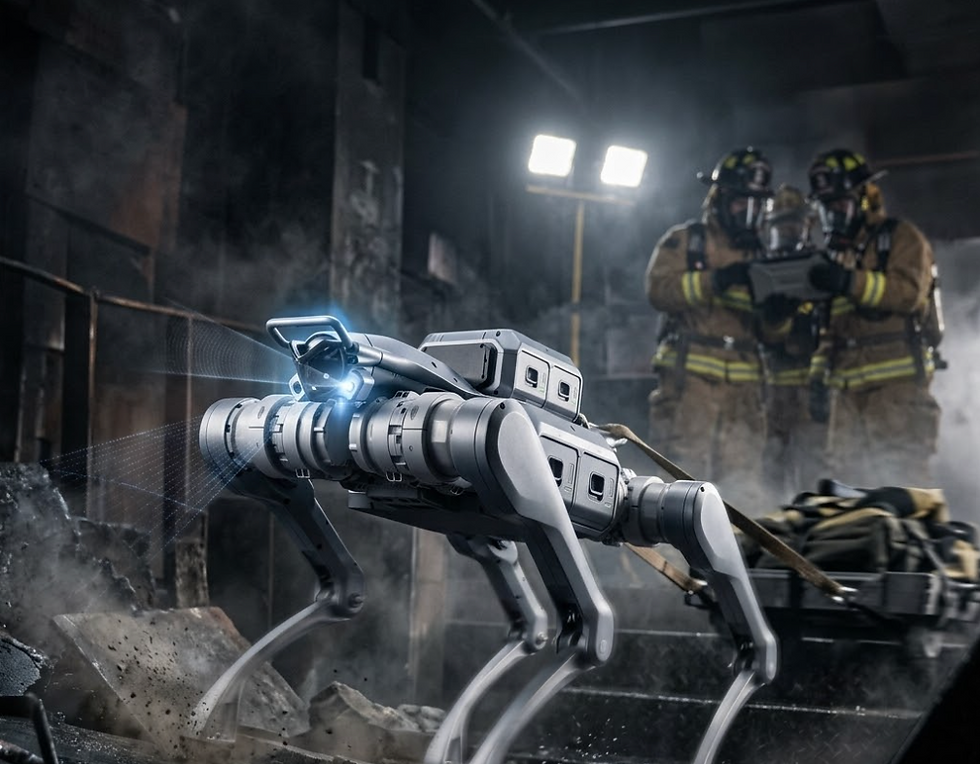
The A2 Stellar Hunter category belongs in a comparison with mobile inspection labor and facility sensing infrastructure. Treating it as a substitute for a precision welding arm creates a false contest and sends capital toward the wrong automation class.
When does fixed automation remain the correct answer?
Fixed automation wins when a high-volume task has stable part presentation, known forces, tight tolerances, and enough throughput to justify dedicated guarding and fixturing. Its economics come from repeatability at one work point and a process designed around that station.
A quadruped wins when the work is distributed across stairs, uneven ground, outdoor transitions, and changing routes. This is where the comparison gets interesting because repeated mobile rounds produce physical datasets that improve maintenance decisions without rebuilding every machine around the robot.
Which A2 configurations fit mobile industrial work?
A2 Pro combines a rugged protected chassis, dual LiDAR, HD vision, GPS and 4G, a high-compute expansion dock, and more than five hours of runtime, which fits repeatable outdoor-capable inspection routes requiring stable sensing and sustained coverage. A2-W uses 7-inch pneumatic wheels on articulated legs with LiDAR, HD vision, and high payload capacity, which fits warehouses, campuses, and perimeter routes dominated by long smooth sections but interrupted by curbs, thresholds, and obstacles.
What should the investment committee compare?
Total Cost of Ownership (TCO) should compare integration, guarding, floor changes, operator labor, maintenance, energy, spares, and route downtime.
Hardware-software integration overhead should include sensor APIs, fleet management, alert routing, network design, and data retention for every mobile mission.
Operational edge cases should be priced explicitly, including blocked paths, weather, connectivity loss, people entering the route, and retrieval after a fault.
Pilot-to-production pipelines should require measurable coverage, intervention rate, anomaly quality, and labor displacement before fleet expansion increases deployment friction.
Where does Toborlife AI change the commercial equation?
Toborlife AI has already narrowed the A2 family into legged and wheeled-leg configurations tied to route economics, sensing loads, and environmental constraints. The U.S. distributor layer consolidates configuration, accessories, freight, warranty context, and engineering diligence into a purchase package procurement can defend.
The approval discussion should include current inspection labor, route geometry, sensor outputs, and the threshold for acceptable intervention. Toborlife AI has already managed the tier-one implementation friction, and the industrial commercial review settles whether the right answer is fixed automation, a quadruped, or a coordinated combination before hardware enters the plant.


Comments