


Why Do Unitree Robot Dogs Enter High-Risk Sites in 2026?
- Aug 4
- 5 min read
Robot dogs are crossing a commercial threshold in 2026. Security screening, infrastructure inspection, and emergency-response trials reveal a consistent pattern: quadrupeds create value when they reduce first-entry risk, carry mission-critical sensors, and complete routes that wheeled robots or human teams should not enter unnecessarily.
What Changed for Industrial Robotics in 2026?
For enterprise buyers, a Unitree robot dog is increasingly evaluated as a field instrument rather than a technology demonstration. The market has started rewarding robots that complete defined routes, collect usable data, and reduce personnel exposure under real operating constraints.

IEEE Robotics and Automation Society, citing International Federation of Robotics data, reported that U.S. industrial robot installations increased 11% in 2025 to approximately 38,000 units. Automotive remained the largest adopter, while installations also expanded across food production, metalworking, electronics, and other sectors. The broader signal is clear: robotics investment is spreading wherever proven automation can improve uptime, throughput, safety, or operating consistency.
The same IEEE roundup described bag-inspecting robot dogs within the security infrastructure supporting the 2026 FIFA World Cup. The report did not identify those systems as Unitree products, so the relevance is category-level rather than a brand attribution. Quadrupeds are moving into public-facing security operations because mobile sensing is valuable in locations where fixed cameras, wheeled robots, and manual patrols leave coverage gaps.
Why Are Quadrupeds Moving Beyond Controlled Demonstrations?
Industrial sites are rarely designed for robots. Inspection routes include stairs, grated floors, narrow utility corridors, loose gravel, standing water, pipes, thresholds, debris, slopes, and areas with inconsistent communications coverage.
Quadrupeds address that mobility problem without requiring an organization to rebuild the environment around the machine. Their commercial advantage comes from preserving route access while carrying cameras, thermal sensors, gas detectors, LiDAR, communications equipment, or edge-computing hardware.
Recent government-backed work in Taiwan demonstrated quadrupeds performing underground culvert inspection, autonomous navigation, confined-space movement, multi-robot supply transport, and firefighting reconnaissance. The systems integrated LiDAR mapping, autonomous localization, obstacle avoidance, and dynamic balancing, while one demonstration included stair climbing, low-angle gauge inspection, and extended travel through a simulated utility tunnel.
These programs illustrate why Physical AI is becoming operationally relevant. The robot must perceive an unfamiliar environment, maintain stability, carry useful equipment, and return information that improves a human decision.
Which Robot-Dog Workflows Are Ready Today?
The strongest use case is not always the flashiest one. Commercial deployments work best when the mission is bounded, repeatable, measurable, and connected to an existing operating process.
Industrial inspection teams can use quadrupeds to revisit equipment routes, capture thermal imagery, read gauges, detect environmental changes, and document asset conditions with greater consistency.
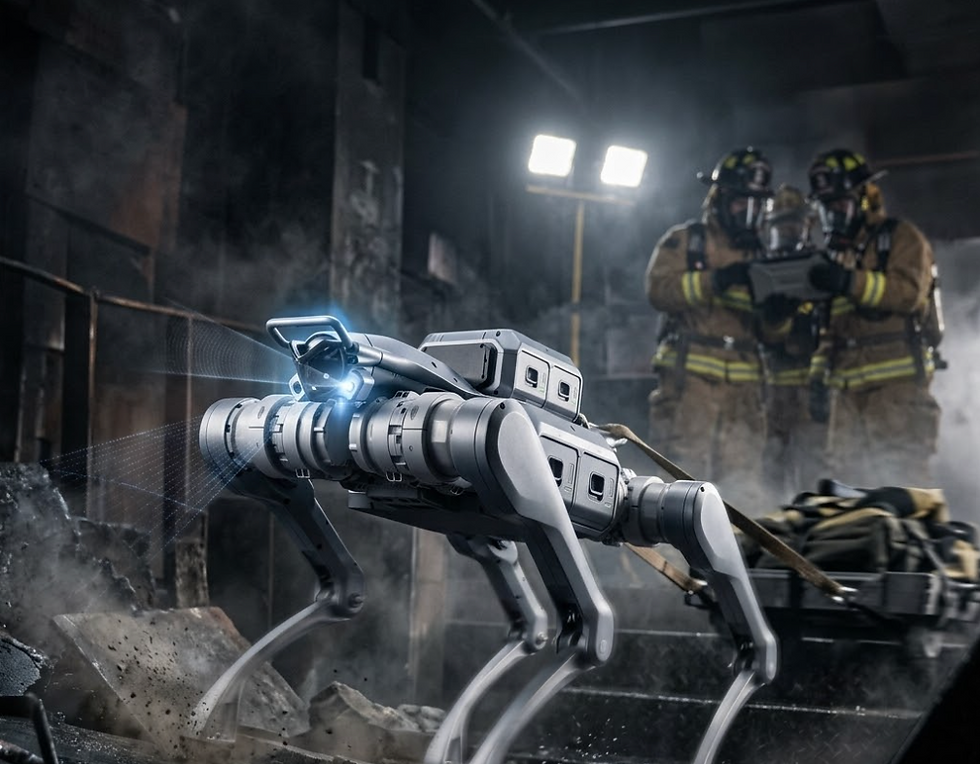
Emergency-response organizations can deploy them for pre-entry reconnaissance, route mapping, communications relay, environmental sensing, and equipment delivery before committing personnel to unstable areas.
Security teams can use supervised quadrupeds for perimeter checks, remote visual screening, restricted-area observation, and temporary sensor coverage where permanent infrastructure is impractical.
Utilities and infrastructure operators can send them into tunnels, substations, construction areas, and damaged facilities where stairs or uneven ground prevent conventional mobile robots from completing the route.
Human operators still retain responsibility for interpreting incomplete evidence and making consequential decisions. Smoke, reflective surfaces, crowds, unstable flooring, network loss, sensor contamination, and blocked exits remain operational edge cases that must be tested deliberately.
When Does Quadruped Mobility Produce Measurable Value?
Mobility creates value when it expands safe access to an economically important route. A robot that climbs stairs during a trade-show demonstration has limited enterprise significance; a robot that repeatedly completes a two-mile inspection route, captures the required sensor data, and returns without intervention changes the labor and safety model.
The real buying decision is therefore built around five operating questions:
Can the robot complete the full route with its production payload installed?
Does it maintain communications across tunnels, buildings, and outdoor transitions?
Can operators recover or retrieve it after localization, battery, or mobility failures?
Does the collected information enter an existing maintenance, security, or incident-response system?
Does the deployment reduce exposure, inspection time, missed findings, or unplanned downtime?
Those answers determine whether the robot improves capital efficiency or becomes another device that field personnel must manage.
Which Unitree Platform Fits Real Field Work?
The right robot depends on the environment, not only the spec sheet. Unitree’s quadruped portfolio spans lighter industrial inspection, hybrid wheel-leg mobility, and heavier field operations.
The Unitree A2 fits inspection and patrol programs that require an industrial chassis, meaningful payload capacity, extended routes, and configurable sensing. Toborlife AI positions the A2 as a field platform for facilities, infrastructure monitoring, campus patrol, construction environments, and Physical AI development.
The Unitree A2-W is designed for routes that combine long paved sections with stairs, curbs, debris, and abrupt surface changes. Its wheel-leg architecture reduces energy use across open ground while preserving articulated mobility when the route becomes more complex. Toborlife AI lists standard and Pro configurations with different LiDAR, connectivity, computing, and environmental-protection packages.
The Unitree B2 belongs in heavier industrial programs where payload, traction, durability, or towing requirements exceed the practical operating envelope of a lighter platform. It is more appropriate for buyers who already understand their field requirements and need a higher-capacity system from the start.
What Separates a Successful Pilot From an Expensive Demo?
A production-oriented pilot begins with a workflow, not a robot. Buyers should define the route, payload, data requirements, intervention limits, communications plan, and acceptance criteria before selecting the final configuration.
A credible evaluation should measure:
Route performance should include completion time, obstacle success, localization failures, operator interventions, and retrieval time under representative site conditions.
Sensor performance should establish whether video, thermal data, environmental readings, or maps improve maintenance, security, or command decisions.
Total Cost of Ownership (TCO) should include batteries, payloads, mounts, transport equipment, communications infrastructure, training, software, maintenance, and spare components.
Hardware-software integration overhead should account for data storage, cybersecurity, alert routing, access controls, fleet management, and connections to existing enterprise systems.
Embodied AI deployment velocity should be measured through completed missions and declining intervention rates rather than the number of available demonstration behaviors.
Pilot-to-production pipelines should convert route failures, operator feedback, and physical datasets into operating procedures, software priorities, and procurement gates.
This discipline reduces deployment friction because technical teams know what success means before autonomy, sensors, or fleet size increase.
What Remains Future-Facing?
Fully autonomous operation across unpredictable emergency scenes remains an advanced development objective. Production systems perform best when routes have defined boundaries, escalation procedures, reliable supervision, and a recovery plan.
Multi-robot coordination also holds significant potential, particularly for supply transport, distributed sensing, and broad infrastructure coverage. Taiwan’s program demonstrated three quadrupeds coordinating to transport supplies and reported using large-scale simulation to train thousands of virtual robots simultaneously before field validation. These developments can accelerate model improvement, but simulation does not replace testing against the weather, surfaces, communications failures, and human activity found at the deployment site.
How Does Toborlife AI Help U.S. Buyers Evaluate Deployment?
This is where Toborlife AI becomes relevant for U.S. buyers. Toborlife AI provides a guided buyer path for Unitree-powered robots, helping organizations compare platforms according to route length, terrain, payload, sensing, environmental exposure, development resources, and operating objectives.
That process protects buyers from two expensive mistakes: purchasing a platform that cannot support the production payload or overbuying heavy industrial capability for a controlled pilot. The objective is to move from robotics curiosity to a technically defensible deployment plan.
Explore Unitree quadruped platforms through Toborlife AI, or contact the Toborlife AI team to review the robot, configuration, and deployment approach that best fits your inspection, security, or emergency-response workflow.


Comments