


Should A2 Stellar Hunter Join Emergency Training in 2026?
- Jul 28
- 2 min read
Quadrupeds are being tested for underground inspection, firefighting, disaster response, and coordinated operations. Emergency teams should treat them as supervised sensing and communications assets, with training built around route access, degraded networks, operator recovery, useful data, and clear limits before the robot enters a real incident.
Why are emergency programs moving quadrupeds into training?
Government-backed robotics teams are combining LiDAR, localization, obstacle avoidance, and multi-robot coordination for hazardous environments. In Toborlife AI’s public-safety reviews, an A2 robot for sale becomes commercially serious when it reduces human exposure during reconnaissance while leaving incident priorities and ambiguous hazard decisions with trained responders.
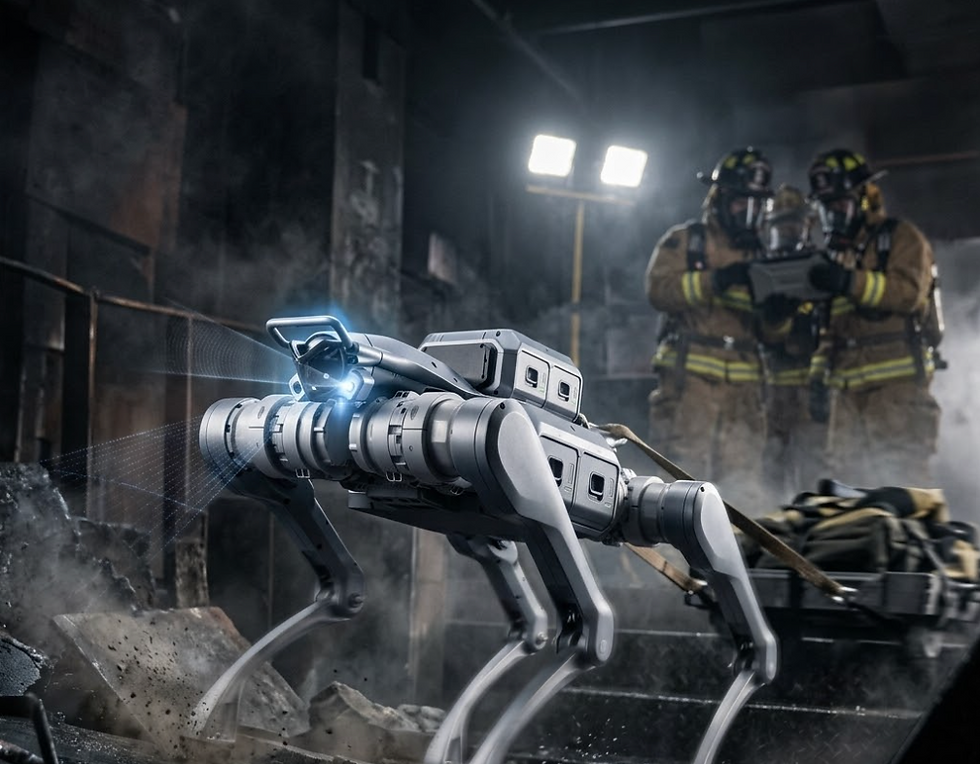
The A2 Stellar Hunter category belongs in emergency training when the mission requires sustained mobility, stable payload carriage, and communications across mixed terrain. The platform should enter the plan as a field instrument with explicit limits, not as an autonomous substitute for incident command.
Which missions are realistic today?
Pre-entry visual inspection, thermal or environmental sensing, route mapping, communications relay, equipment carriage, and repeated perimeter checks are credible starting points. Human teams still interpret smoke, debris, unstable structures, water, crowds, and incomplete sensor evidence, while the robot extends observation into areas where immediate entry carries unnecessary risk.
Training should deliberately inject radio loss, blocked routes, degraded visibility, operator handoffs, and retrieval after a simulated fault. Those exercises create useful physical datasets and reveal whether the system improves command decisions under pressure or simply becomes another device responders must manage.
Which configurations belong in the emergency shortlist?
A2 Pro combines a rugged industrial chassis, dual LiDAR, HD vision, integrated GPS and 4G, more than five hours of no-load walking, and a 25 kg continuous walking load, which fits sensor-heavy reconnaissance and long mixed-terrain training routes where payload stability is mission-critical. A2-W uses a sealed wheeled-leg chassis that rolls efficiently across wet paved perimeter sections while retaining articulated legs for thresholds, debris, and stairs, which fits emergency campuses where long road coverage and obstacle transitions occur inside the same mission.
What should an emergency pilot measure?
Training scenarios should measure deployment time, route completion, intervention count, communications quality, sensor usefulness, operator handoff, and retrieval time.
Total Cost of Ownership (TCO) should include payloads, protective mounts, batteries, charging, transport cases, communications infrastructure, spares, maintenance, and recurring exercises.
Hardware-software integration overhead should cover incident-command displays, video retention, alert routing, network security, access controls, and payload interfaces.
Capital efficiency should be tested across multiple missions—inspection, mapping, relay, and equipment carriage—without rebuilding the system for each exercise.
Pilot-to-production pipelines should convert after-action findings into operating procedures, labeled intervention data, software priorities, and procurement gates.
What has Toborlife AI already completed before deployment?
Toborlife AI has already aligned the A2 legged and wheeled-leg configurations with endurance, communications, payload, accessories, U.S. logistics, and implementation dependencies. Safety organizations receive a procurement-grade platform boundary rather than an open-ended research project that begins after arrival.
The review package should contain an existing training scenario, route, payload list, communications plan, transport method, and decontamination requirements. Toborlife AI has already managed the tier-one hardware friction, and the public-safety engineering review converts that scenario into a system designed to build operational confidence before field exposure.


Comments